
Anthropic releases Claude Opus 4.8: How to use it to analyse your finances with Lebon Consulting
Lebon Consulting is bringing Anthropic's Claude Opus 4.8 into Lebon AI for bank statement analysis, credit reviews, and insurance gap checks under adviser oversight.
What this article gets at
A tool, not an adviser
Claude AI reads and structures your documents. The advice itself stays with a FAIS-authorised representative.
Your data stays protected
Statements run through Anthropic's enterprise API under POPIA. We do not train external models on your information.
Always adviser-reviewed
Every output is checked by your adviser before it informs a recommendation, so accuracy is never assumed.
Educational content only. This is not personal financial advice. AI-assisted analysis supports your adviser and is reviewed before any recommendation reaches you.
On this page
Claude Opus 4.8 is the latest flagship large language model from Anthropic, released in May 2026. Lebon Consulting is integrating it into our Lebon AI platform to read and structure financial documents — bank statements, credit reports and insurance schedules — so a FAIS-authorised adviser can give faster, better-evidenced advice. The AI does the reading and structuring; the advice and every recommendation still come from a registered human adviser.
Overview
- Claude AI's latest release, Opus 4.8 from Anthropic, brings sharper reasoning and longer context windows that are useful for analysing financial documents.
- Lebon Consulting clients will get access to Claude AI through our Lebon AI platform, secured via API, to review bank statements, credit reports, and existing insurance cover.
- The model assists your adviser: it does not replace FAIS-regulated advice, and all outputs are reviewed by a registered adviser before recommendations reach you.
- Practical use cases include cash-flow analysis, identifying duplicate cover, spotting policy gaps, and modelling two-pot retirement scenarios.
- Your data is handled under POPIA: we do not train external models on your statements, and access is scoped to your authorised adviser.
Anthropic has just released Claude Opus 4.8, and the practical question for South African clients is simple: how does a smarter Claude AI model actually help you make better financial decisions? At Lebon Consulting we are currently evaluating the model against the kind of work our advisers do every week, things like reading 12 months of bank statements, cross-referencing a credit report, and pulling apart a stack of insurance schedules to find duplicate cover. Early indications are promising, and we are working to roll access out to clients through our Lebon AI financial wellness platform.
This article explains what changed in Opus 4.8, how we use it inside our advice process, and where the limits sit. If you want the deep technical detail on the model itself, Anthropic's official Opus 4.8 release notes cover the benchmarks.
What is Claude Opus 4.8?
Claude Opus 4.8 is the latest flagship model from Anthropic, the AI lab behind the Claude family of large language models. Think of it as a more capable version of the assistant you may have already used in chat form, with three improvements that matter for financial work:
- Longer context windows. The model can now hold significantly more text in working memory at once. In practice, that means it can read a full year of bank statements, a credit bureau report, and three insurance policy schedules in one pass, without losing track of what it saw on page one.
- Better numerical reasoning. Earlier models were strong at language but wobbly on arithmetic. Opus 4.8 handles structured numeric data, percentages, and multi-step calculations more reliably, which is exactly what you need when you are reconciling income against debit orders.
- Improved instruction-following. When an adviser asks the model to produce output in a specific format, for example a table of recurring expenses categorised by type, it sticks to the brief.
None of this makes Claude AI a financial adviser. It is still a tool that needs a human in the loop, particularly under FAIS, where advice must come from an authorised representative. What it does well is the heavy lifting of reading, summarising, and structuring information, which is where advisers usually lose hours.
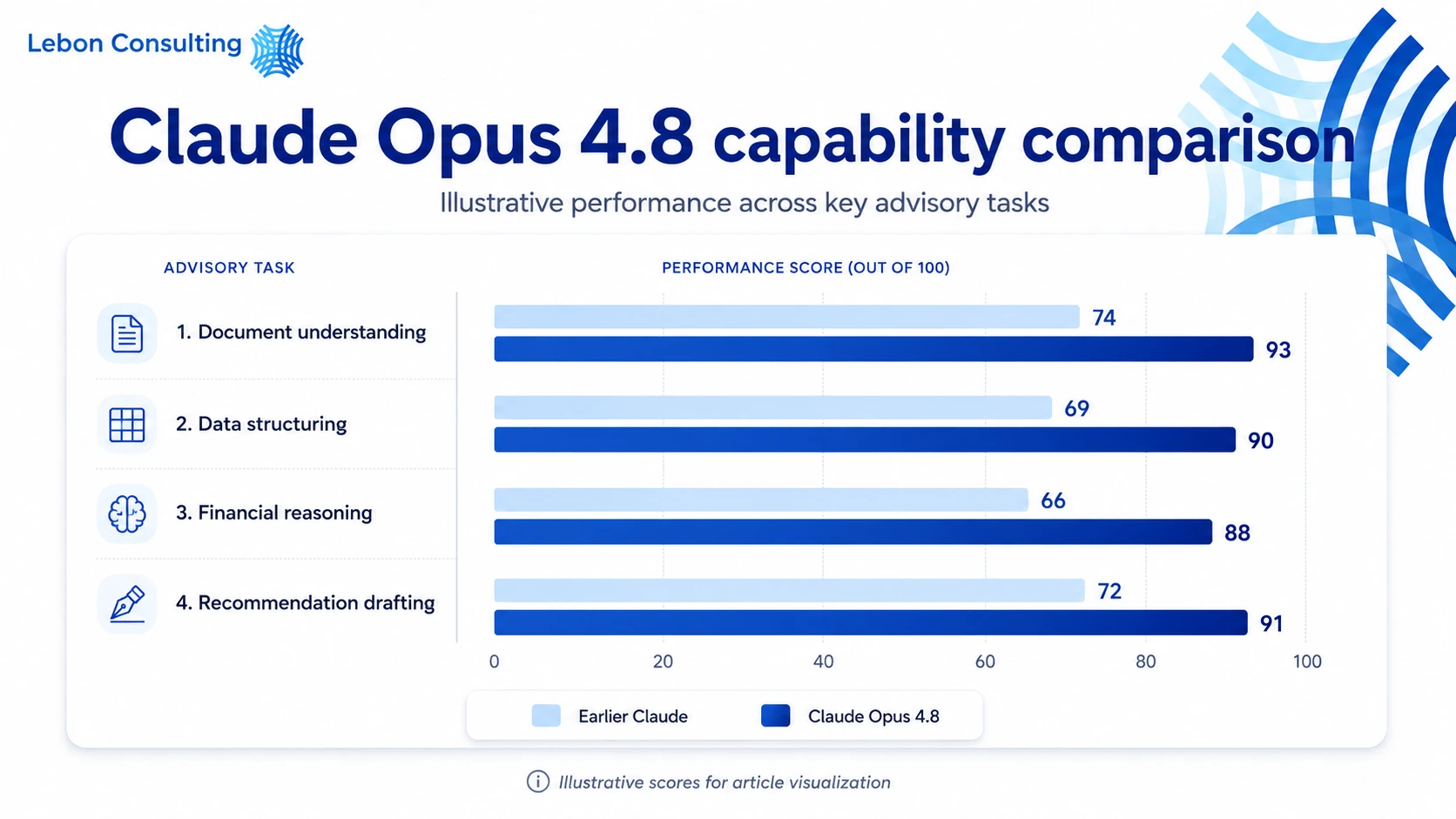
How Opus 4.8 compares to earlier models for financial tasks
| Task | Earlier Claude models | Opus 4.8 |
|---|---|---|
| Read 12 months of bank statements in one go | Often truncated | Handles in single context |
| Categorise recurring debit orders | Reasonable | More consistent |
| Cross-reference policy schedule against needs analysis | Required chunking | Done in one pass |
| Spot duplicate cover across two insurers | Hit and miss | Reliable when prompted clearly |
The table is illustrative, reflecting our early evaluation on anonymised sample documents rather than a published benchmark.
How does Claude AI improve access to good financial advice?
Good financial advice has always been bottlenecked by adviser time. A proper review of your situation involves reading documents you may not even have organised yet, asking follow-up questions, modelling a few scenarios, and writing up recommendations. That work is valuable, but the reading-and-structuring portion does not need to be done by a human at R-per-hour rates. This is where Claude AI changes the economics.
Here is how we plan to use Opus 4.8 inside Lebon AI:
Bank statement analysis in minutes, not hours
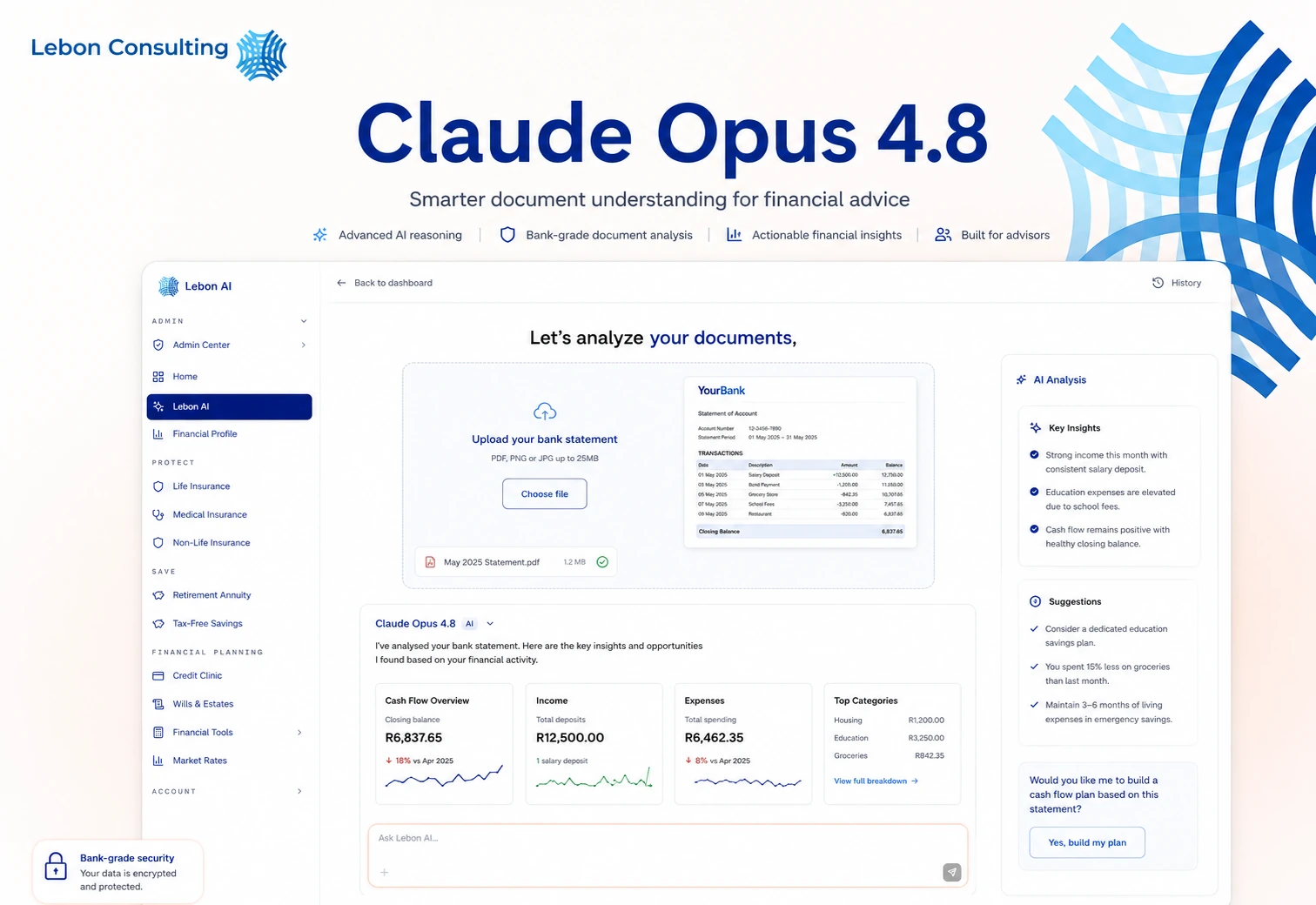
You upload 6 to 12 months of statements to your secure client area on our client portal. The model categorises every transaction, separates fixed costs from discretionary spend, flags recurring debit orders, and produces a clean cash-flow summary. Your adviser then reviews the output, corrects any miscategorisations, and uses it as the starting point for your budget and affordability discussion.
What this means for you: the conversation with your adviser starts at "here is what your money is actually doing" rather than "let's try to remember what you spent on last March".
Credit report review
A credit bureau report is dense. Opus 4.8 reads it end to end, identifies any accounts in arrears, summarises your total credit exposure, calculates your debt-to-income ratio, and highlights any data inconsistencies that you may want to dispute with the bureau directly. This is especially useful if you are preparing to apply for a home loan and want to clean up your profile first, which is part of our Credit Clinic work.
Insurance reviews and gap analysis
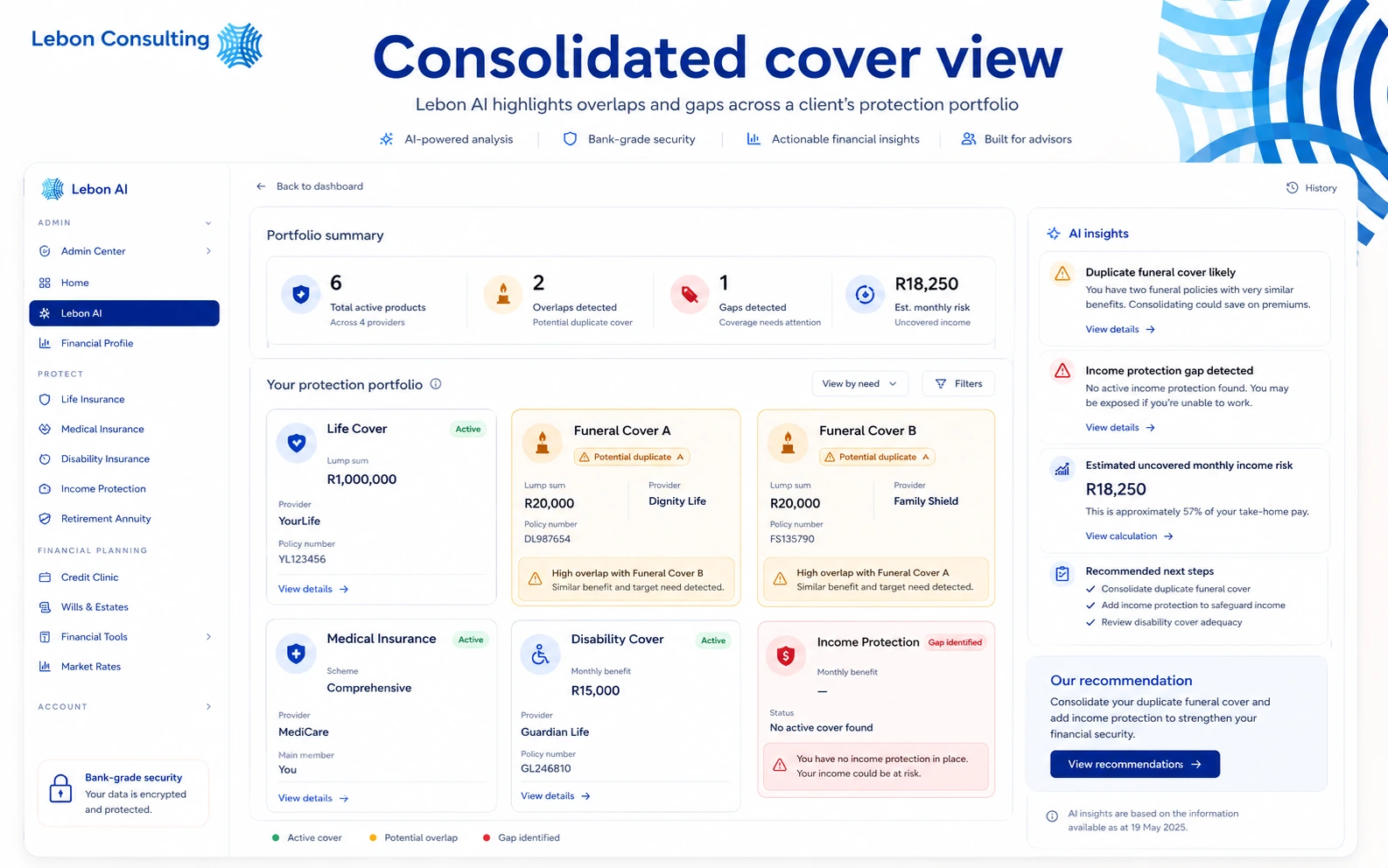
This is where the model earns its keep. Most clients walk in with cover spread across two or three insurers, accumulated over years. The model reads each schedule, builds a single consolidated view of what you are covered for, calculates total monthly premiums, and compares the result against a needs analysis your adviser has set up. Common findings include:
- Disability cover that has not been escalated as your income grew
- Two life policies with overlapping benefits, costing more than one well-structured policy would
- No income protection at all, despite a household that depends on one salary
- Funeral cover bundled into a life policy at a premium that exceeds standalone alternatives
Your adviser uses the model's structured output to drive the conversation, then makes a recommendation under FAIS rules using our 11-insurer panel. You can read more about how we approach life cover as part of this.
Two-pot retirement modelling
Since 1 September 2024, all new retirement contributions are split into a savings pot (one-third, accessible once per tax year) and a retirement pot (two-thirds, only at retirement). The model helps your adviser run scenarios: what does an annual savings-pot withdrawal cost you in tax now, and what does it cost your retirement value in 20 years? You see the trade-off in rands, not in abstract percentages.
Why route Claude AI access through Lebon AI?
You could open a Claude chat yourself and paste in documents. We do not recommend it, for three reasons.
Compliance and privacy. Your bank statements, credit reports, and policy schedules contain personal information protected under POPIA. Pasting them into a consumer chat interface creates a data trail you do not control. Lebon AI runs the model through Anthropic's API under an enterprise agreement, with prompts and outputs handled inside our controlled environment. We do not allow your data to be used for external model training.
Advice quality. A general chat can produce a plausible-sounding answer that is wrong for the South African context, for example confusing a medical aid with a hospital plan, or misstating the two-pot rules. Our Lebon AI configuration is grounded in the actual SA regulatory and product environment, and outputs go through a registered adviser before they reach you.
Integration with your file. When you use Lebon AI through your secure client area, the model's outputs land directly in your file. Your adviser sees them, you see them, and they become part of your advice record, which is itself a FAIS requirement.
You can read more about how we build these systems on our technology page.
How do you get started with Lebon AI?
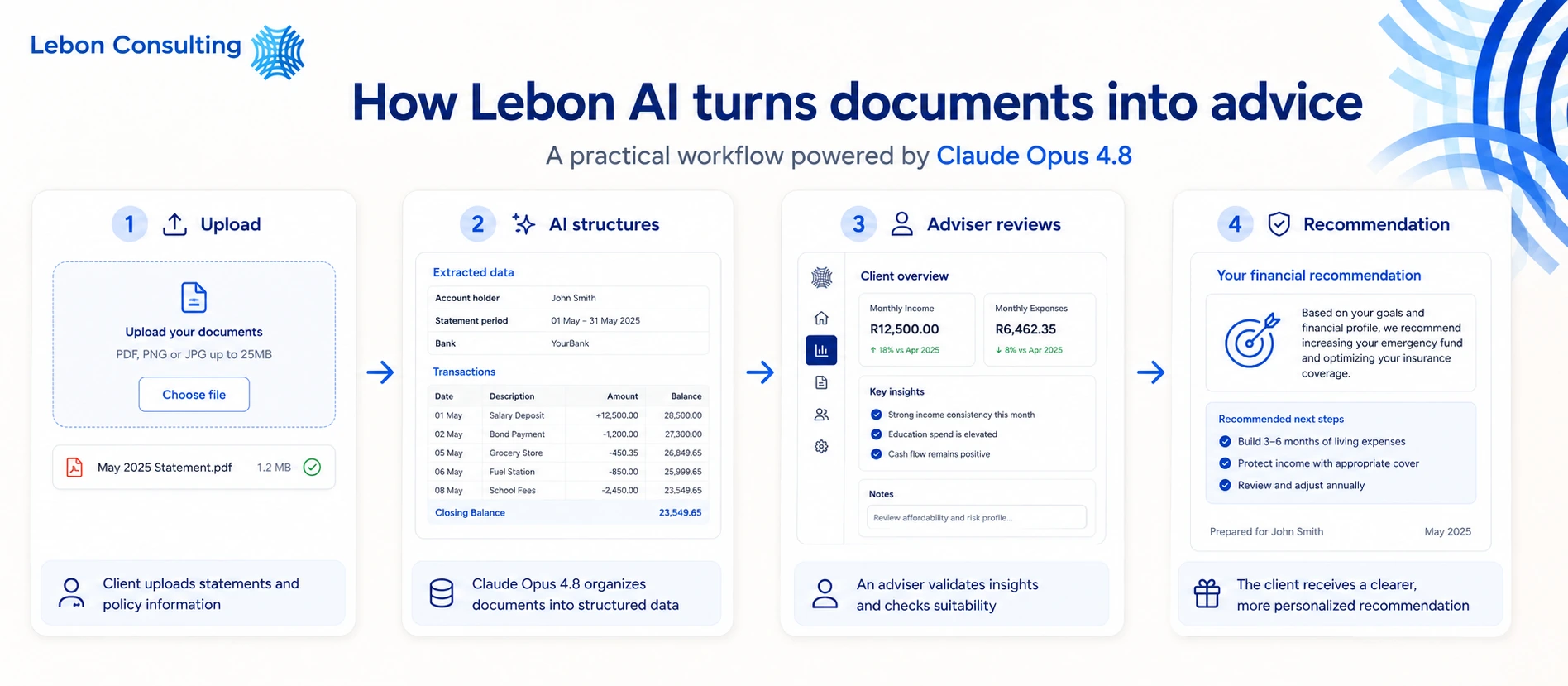
Getting your finances analysed through Lebon AI follows four simple steps:
- Book a needs analysis with a Lebon Consulting adviser, either through the client portal or on WhatsApp.
- Upload your documents to your secure client area: 6 to 12 months of bank statements, your latest credit report, and any existing policy schedules.
- Claude Opus 4.8 reads and structures the documents inside Lebon AI, producing cash-flow summaries, a consolidated cover view, and any scenario models your adviser requests.
- Your adviser reviews every output, corrects anything that needs it, and walks you through the recommendation under FAIS rules.
What Claude AI cannot do for your finances
It is worth being honest about the limits.
- It cannot give you personal financial advice. That role sits with a FAIS-authorised representative.
- It cannot guarantee accuracy on every transaction it categorises. Always review the output.
- It does not have real-time access to your bank accounts or product providers. It works on the documents you provide.
- It is not a substitute for full underwriting. Life and disability cover still go through the insurer's underwriting process, and outcomes are subject to policy terms.
The right way to think about Claude AI in financial services is as a research and structuring assistant for your adviser, not a replacement for the adviser themselves.
Where Claude AI fits in the bigger picture
The deeper point is this: better tools make good advice cheaper to deliver, and cheaper to deliver means more South Africans can access it. Most people in this country do not have a financial adviser, not because they do not want one, but because the cost of doing the work properly has been high relative to the size of their assets. Claude AI does not solve that on its own, but it shifts the economics in the right direction. That is why we are building Lebon AI on top of it, and why we will keep updating the platform as Anthropic releases new model versions.
If you want to see what your own finances look like through this lens, the next step is a review with one of our advisers.
This article is for educational purposes only and does not constitute personal financial advice. Lebon Consulting is an authorised Financial Services Provider, FSP No. 52013. For a personalised recommendation based on your circumstances, contact us directly or visit app.lebonconsulting.co.za.
Lebon Consulting
Reviewed by Isaiah Mphaloane, Lead Advisor and Key Individual (FSCA Fit and Proper). Authorised Financial Services Provider, FSP 52013. Articles are reviewed for compliance before publication and reflect the perspective of a licensed adviser, not the product provider.
Continue reading
Frequently asked questions
What is Claude Opus 4.8 in plain terms?
It is the latest large language model from Anthropic, released as their flagship Opus tier. For our purposes, it is the engine that reads and structures the documents you bring to a financial review.
Is my data safe when Lebon AI uses Claude?
Yes. Access runs through Anthropic's enterprise API under our agreement, your prompts are not used to train external models, and the workflow is governed by POPIA. Access is scoped to your authorised adviser.
Will Lebon AI replace my adviser?
No. Under FAIS, advice and intermediary services must be provided by an authorised representative. Lebon AI handles document reading, structuring, and scenario modelling. The advice itself comes from your adviser, who reviews everything before it reaches you.
How do I get access?
If you are an existing Lebon Consulting client, access is being rolled out through your client portal at app.lebonconsulting.co.za. If you are new to us, the starting point is a needs analysis with one of our advisers, after which the platform becomes part of your ongoing review process.
Does it cost extra?
For advisory clients, Lebon AI is included in the advice relationship. We do not charge a separate platform fee.
Can it analyse my medical aid or hospital plan cover too?
Yes. The model reads scheme benefit summaries and Flexicare hospital plan schedules alongside other cover, so your adviser can see your full risk picture in one view. Note that hospital plans and medical schemes are different products and should not be treated as equivalent.
What if it gets something wrong?
That is exactly why your adviser reviews every output before it informs a recommendation. If you spot something that looks off in your dashboard, raise it with your adviser and it gets corrected.
Make Lebon Consulting a Preferred Source
Want South African financial guidance you can trust to show up in Google's AI answers? In Google Search, open Search personalisation → Preferred sources and add lebonconsulting.co.za. Preferred sources are highlighted in AI Overviews and AI Mode.
Recent articles for South African policyholders.
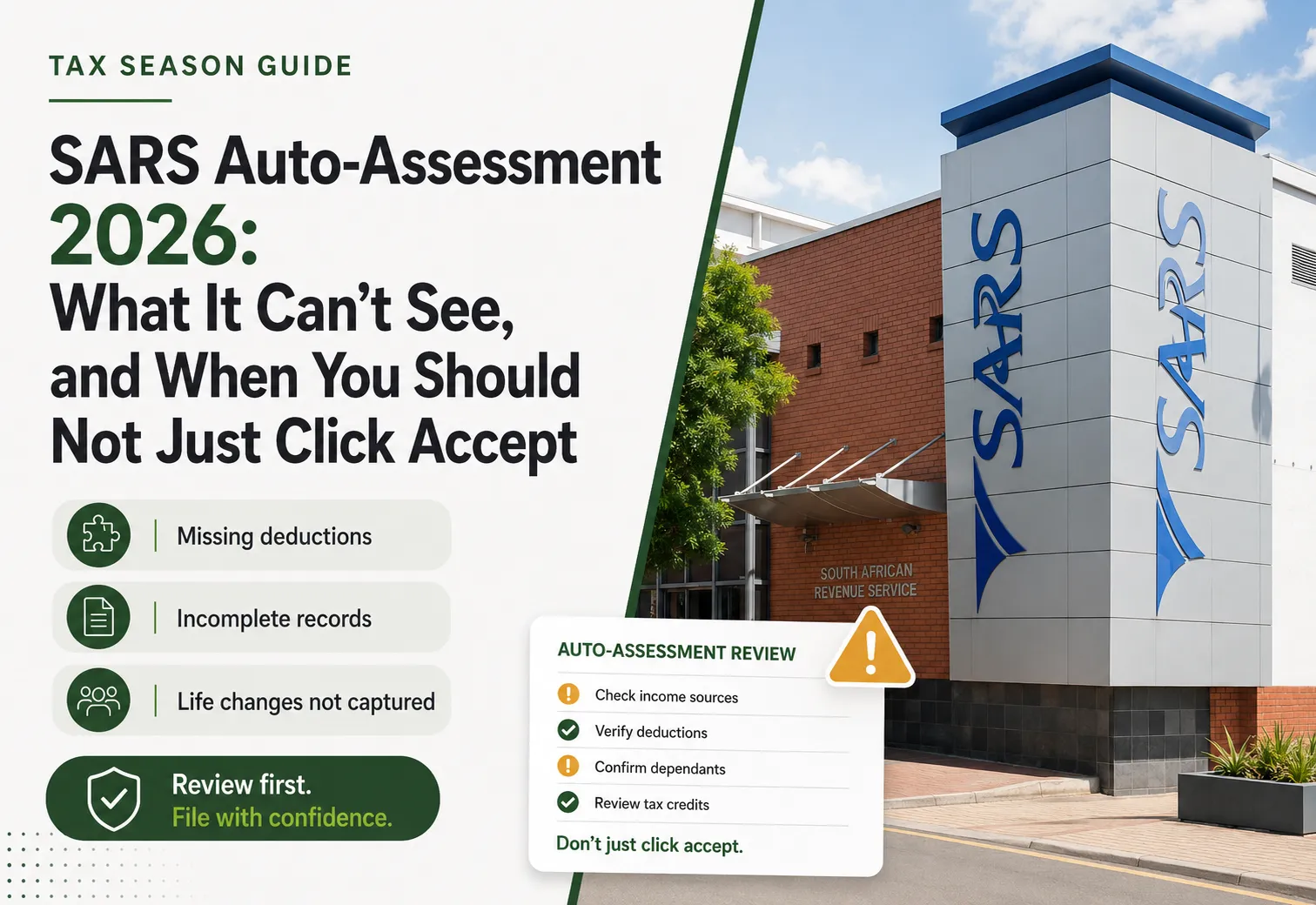
SARS Auto-Assessment 2026: What It Can't See, and When You Should Not Just Click Accept
SARS pre-fills millions of returns from third-party data — but it can't see out-of-pocket medical, donations, side income or RA top-ups. Here's the decision rule before you click accept.
Read article
Tax Calculator 2026 (South Africa): SARS 2026/27 Rates & the Four Levers That Move Your Answer
Calculate your 2026 South African income tax and take-home pay, then watch four legal levers — retirement, donations, a TFSA and your medical credit — redraw where your salary actually goes.
Read article
King Price Insurance: Decreasing Car Insurance Premiums Explained for South Africans
How King Price Insurance's decreasing comprehensive car insurance premiums work, what is covered, and how to compare it against other South African insurers.
Read articleCompare the panel before you commit to a single insurer.
Request a personalised comparison through the client portal, or speak with an authorised adviser on WhatsApp. We compare across the full Lebon panel — including Discovery, Sanlam, Old Mutual and Momentum.
Next steps
- 01EstimateUse the life cover calculator to frame the need.
- 02CompareReview panel options across premium, benefits and exclusions.
- 03ApplyProceed through the Lebon Consulting client portal when the advice record is clear.