
SARS Auto-Assessment 2026: What It Can't See, and When You Should Not Just Click Accept
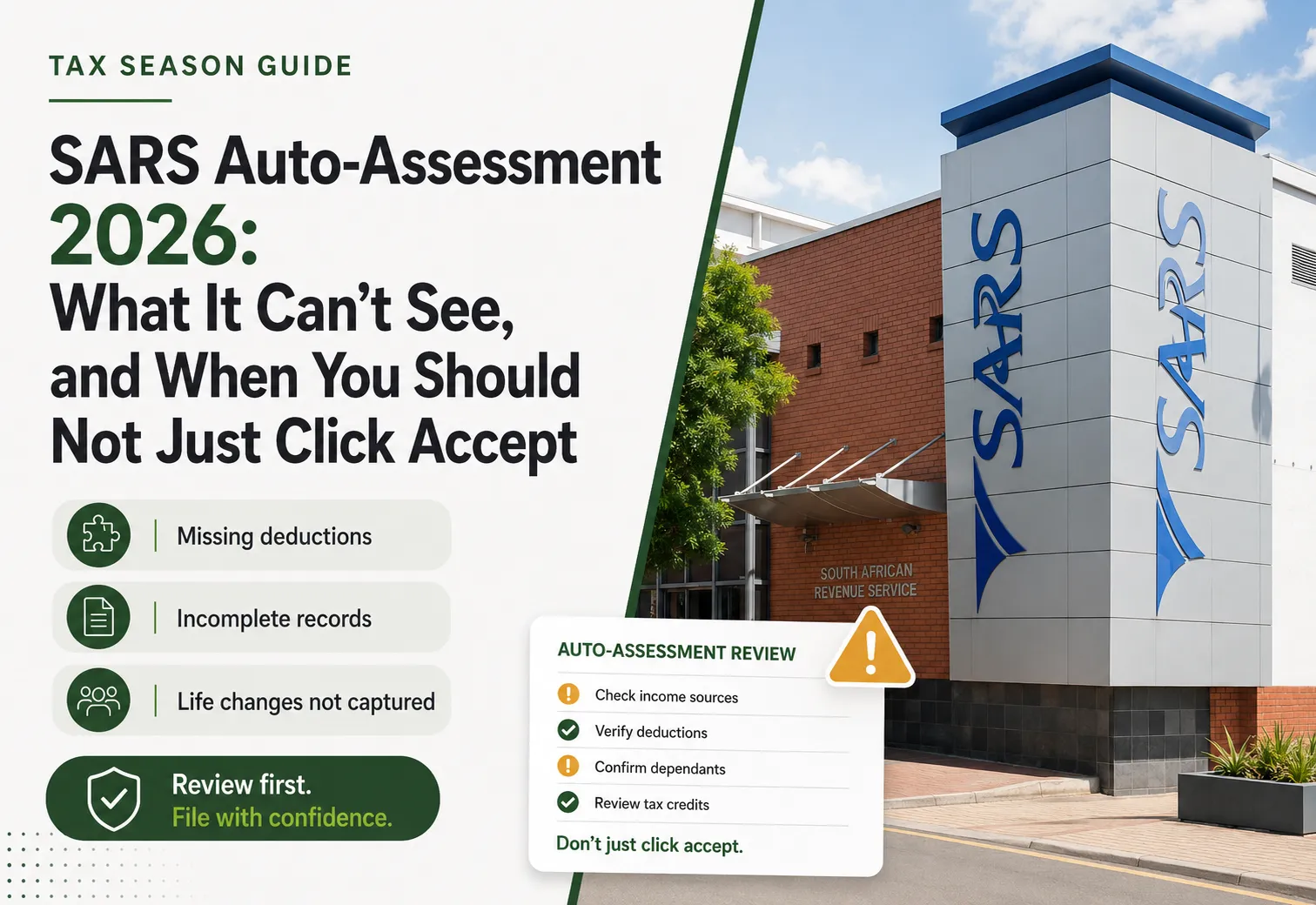
SARS pre-fills millions of returns from third-party data — but it can't see out-of-pocket medical, donations, side income or RA top-ups. Here's the decision rule before you click accept.
What this article gets at
Not a brand contest
The right insurer depends on your underwriting, occupation, benefit definitions and long-term affordability.
Escalation matters
The premium you can afford in year one still needs to make sense when the increases compound.
Vitality is behavioural
Rewards can add value, but only when the client actually engages with the programme requirements.
Educational content only. This is not personal financial advice or a guaranteed insurer quotation. Premiums, definitions and outcomes vary by individual underwriting.
On this page
- 01Overview
- 02What is a SARS auto-assessment?
- 03Who gets auto-assessed and who doesn't?
- 04How does SARS build your auto-assessment?
- 05The 2026 timeline: dates that matter
- 06What can SARS Auto-Assessment 2026 not see?
- 07"Refund" or "amount due": what each outcome really means
- 08Should you accept your auto-assessment? A simple decision rule
- 09How to file a corrected return
- 10The retirement annuity angle most people overlook
- 11Where Lebon Consulting fits
Overview
- SARS Auto-Assessment 2026 uses third-party data from employers, banks, medical schemes, and retirement funds to pre-populate your ITA34 before filing season opens.
- Around 6 million taxpayers are expected to be auto-assessed in 2026, mostly salaried earners with simple tax affairs.
- Auto-assessment cannot see out-of-pocket medical (code 4034), Section 18A donations, travel logbook claims, home-office costs, side or rental income, or private RA top-ups.
- If a refund is due and your details are correct, SARS aims to pay within 72 hours; amounts under R100 roll over to the next tax year.
- Accept only if every income source is reflected and you have no extra deductions to claim. Otherwise, file a corrected return before the deadline.
- The retirement annuity deduction is 27.5% of the higher of taxable income or remuneration, capped at R350,000 for 2025/26 (rising to R430,000 from 1 March 2026).
The SARS Auto-Assessment 2026 process is about to land in millions of inboxes, and the first instinct for many South Africans will be to tap "accept" and move on. That instinct can cost you money, or worse, leave you with an undeclared income problem you didn't know you had. This guide walks through what an auto-assessment actually is, what it cannot see, and the decision rule to apply before you click anything.
What is a SARS auto-assessment?
An auto-assessment is a pre-populated tax return that SARS issues to selected taxpayers at the start of filing season. SARS pulls data from third parties (employers, medical schemes, retirement annuity providers, banks, and investment houses), calculates what it thinks you owe or are owed, and sends you an ITA34 assessment notice via eFiling or the SARS MobiApp.
You can accept it, ignore it (which is treated as acceptance after a window), or file a corrected return. According to SARS guidance on how auto-assessment works, if you do nothing and the assessment is correct, it stands as your final return.
Who gets auto-assessed and who doesn't?
SARS targets taxpayers with relatively simple tax affairs: salaried employees with one or two income sources, standard medical scheme contributions, and retirement fund contributions through their employer. Roughly 6 million taxpayers are expected to be auto-assessed in Filing Season 2026.
You generally won't be auto-assessed if you:
- Are a provisional taxpayer (you earn material income outside PAYE).
- Have rental income, freelance income, or a side business.
- Claim a travel allowance against a logbook.
- Have foreign income or complex investment activity.
Non-provisional taxpayers form the bulk of the auto-assessment pool. If you fall outside that group, you'll need to file the normal way.
How does SARS build your auto-assessment?
SARS receives third-party data submissions from:
- Employers (IRP5 / IT3(a) showing salary, PAYE, UIF, and retirement fund contributions).
- Medical schemes (contribution certificates and code 4020 claims not recovered from the scheme).
- Retirement annuity and pension fund administrators (IT3(f) certificates).
- Banks and investment platforms (IT3(b) interest, IT3(c) capital gains).
- Insurers and section 18A-approved PBOs (for some donation certificates, though not always).
SARS reconciles this against your tax profile and generates the ITA34. The accuracy of your auto-assessment is only as good as the data SARS receives, and only as complete as the categories third parties are obliged to report.
The 2026 timeline: dates that matter
SARS typically runs filing season in a phased rollout. Based on the SARS filing season page and SARS's phased rollout media release, the broad structure is:
- Early to mid-July 2026: auto-assessments issued in batches.
- Mid-July to October 2026: filing season open for non-provisional taxpayers (including those who need to correct an auto-assessment).
- Through January 2027: provisional taxpayer deadline.
SARS asks taxpayers to check their auto-assessment status and wait for the notice rather than logging in repeatedly. If a refund is due and your details check out, SARS aims to pay within 72 hours. Any refund or debt under R100 rolls over to the next year.
What can SARS Auto-Assessment 2026 not see?
This is where most taxpayers leave money on the table, or stumble into a compliance problem. Auto-assessment is built on third-party data, so anything that doesn't come from a third-party feed is invisible.
Out-of-pocket medical expenses (code 4034): medical costs you paid in cash and never submitted to your scheme. These do not appear on your medical scheme certificate and SARS cannot see them. They can still qualify for the additional medical expenses tax credit. Code 4020 (claims submitted but not reimbursed by the scheme) is usually pre-populated. SARS sets out how to declare additional medical expenses on your return.
Section 18A donations: not all approved PBOs submit IT3(d) data yet. Keep your section 18A certificates and check the assessment.
Travel allowance claims: if you receive a travel allowance and keep a SARS-compliant logbook, you may claim against the deemed or actual cost method. SARS doesn't have your logbook.
Home-office deductions: strictly limited. You must use the space regularly and exclusively for work, and meet other requirements. Salaried employees rarely qualify; the bar is high and SARS scrutinises these claims.
Side income and rental income: freelance work, consulting, Airbnb, side hustles, and rental properties are not reported to SARS by third parties. You are legally required to declare this income and may deduct legitimate expenses against it.
Private RA top-ups: contributions made to your own retirement annuity outside payroll. The RA provider issues an IT3(f), but the auto-assessment doesn't always capture top-ups paid late in the tax year or to providers with delayed reporting.
"Refund" or "amount due": what each outcome really means
A refund on the ITA34 means SARS believes it collected more PAYE than you owed. That's good news, but it does not mean the assessment is complete. If you have unclaimed out-of-pocket medical or donations, the refund could be larger. If you have undeclared side income, you may actually owe SARS once that income is added.
An amount due means SARS believes you under-paid. Don't panic and don't accept blindly. Check whether retirement annuity contributions or medical credits are correctly reflected before settling.
Should you accept your auto-assessment? A simple decision rule
Accept the auto-assessment only if all three are true:
- Every source of income you earned in the tax year appears on the ITA34.
- You have no out-of-pocket medical, section 18A donations, travel logbook claims, home-office costs, or private RA top-ups to add.
- The numbers reconcile against your own IRP5, medical certificate, and RA certificate.
If any one of those fails, file a corrected return.
How to file a corrected return
- Log in to eFiling or the SARS MobiApp and open the auto-assessment.
- Select "Edit Return" to switch from acceptance to a corrected submission.
- Add the missing data — medical expenses under code 4034, donation certificate details, additional income, and RA top-ups.
- Upload supporting documents for every figure you add or change.
- Submit, and wait for SARS to reassess and issue a revised ITA34.
Keep records for five years. SARS can request verification at any point in that window.
The retirement annuity angle most people overlook
The RA deduction is one of the most generous tax breaks available to salaried South Africans, and one of the most under-used. You can deduct contributions to a pension fund, provident fund, and retirement annuity up to 27.5% of the higher of taxable income or remuneration, capped at R350,000 for the 2025/26 year of assessment. From 1 March 2026 (2026/27), the cap rises to R430,000.
If your employer-based contributions don't reach that cap, a private RA top-up before year-end can reduce your taxable income materially. Auto-assessment cannot prompt you to do this; it can only reflect what already happened.
You can model the impact using our income tax calculator to see how an additional contribution changes your liability before you commit.
Where Lebon Consulting fits
Lebon Consulting is an authorised Financial Services Provider (FSP No. 52013). We don't file tax returns: that's the role of a registered tax practitioner. What we do is help you structure retirement annuities, group benefits, and protection in ways that work with the tax framework, not against it. If the RA cap conversation is one you want to have before year-end, we're happy to talk it through.
SARS Auto-Assessment 2026 is a useful piece of administrative automation, but it's not a financial plan. Treat it as a starting point, check what's missing, and make the corrections that reflect your actual tax position.
This article is for educational purposes only and does not constitute tax or personal financial advice, and does not consider your personal circumstances. Tax matters specific to your situation should be discussed with a registered tax practitioner; always confirm current rates and deadlines against sars.gov.za. Lebon Consulting is an authorised Financial Services Provider, FSP No. 52013.
Lebon Consulting
Reviewed by Isaiah Mphaloane, Lead Advisor and Key Individual (FSCA Fit and Proper). Authorised Financial Services Provider, FSP 52013. Articles are reviewed for compliance before publication and reflect the perspective of a licensed adviser, not the product provider.
Continue reading
Frequently asked questions
Do I have to accept my auto-assessment?
No. You can file a corrected return within the filing season window. Acceptance is not mandatory; it's the default if you do nothing.
How long does SARS take to pay an auto-assessment refund?
SARS targets 72 hours for refunds where the assessment is correct and banking details are verified. Refunds under R100 roll forward.
What is an ITA34?
It's the assessment notice SARS issues after processing your return (auto or filed). It shows the calculation, the refund or amount due, and the basis for the figures.
Can I reject an auto-assessment after accepting it?
You can still file a corrected return within the filing season window, even after the auto-assessment has "stood". After that window, you'd need to lodge an objection, which is a more formal process.
I have a side hustle. Will SARS find out?
SARS receives data from banks, payment processors, and increasingly from gig platforms. Undeclared income carries penalties and interest. Declare it and deduct legitimate expenses against it.
Make Lebon Consulting a Preferred Source
Want South African financial guidance you can trust to show up in Google's AI answers? In Google Search, open Search personalisation → Preferred sources and add lebonconsulting.co.za. Preferred sources are highlighted in AI Overviews and AI Mode.
Recent articles for South African policyholders.

Tax Calculator 2026 (South Africa): SARS 2026/27 Rates & the Four Levers That Move Your Answer
Calculate your 2026 South African income tax and take-home pay, then watch four legal levers — retirement, donations, a TFSA and your medical credit — redraw where your salary actually goes.
Read article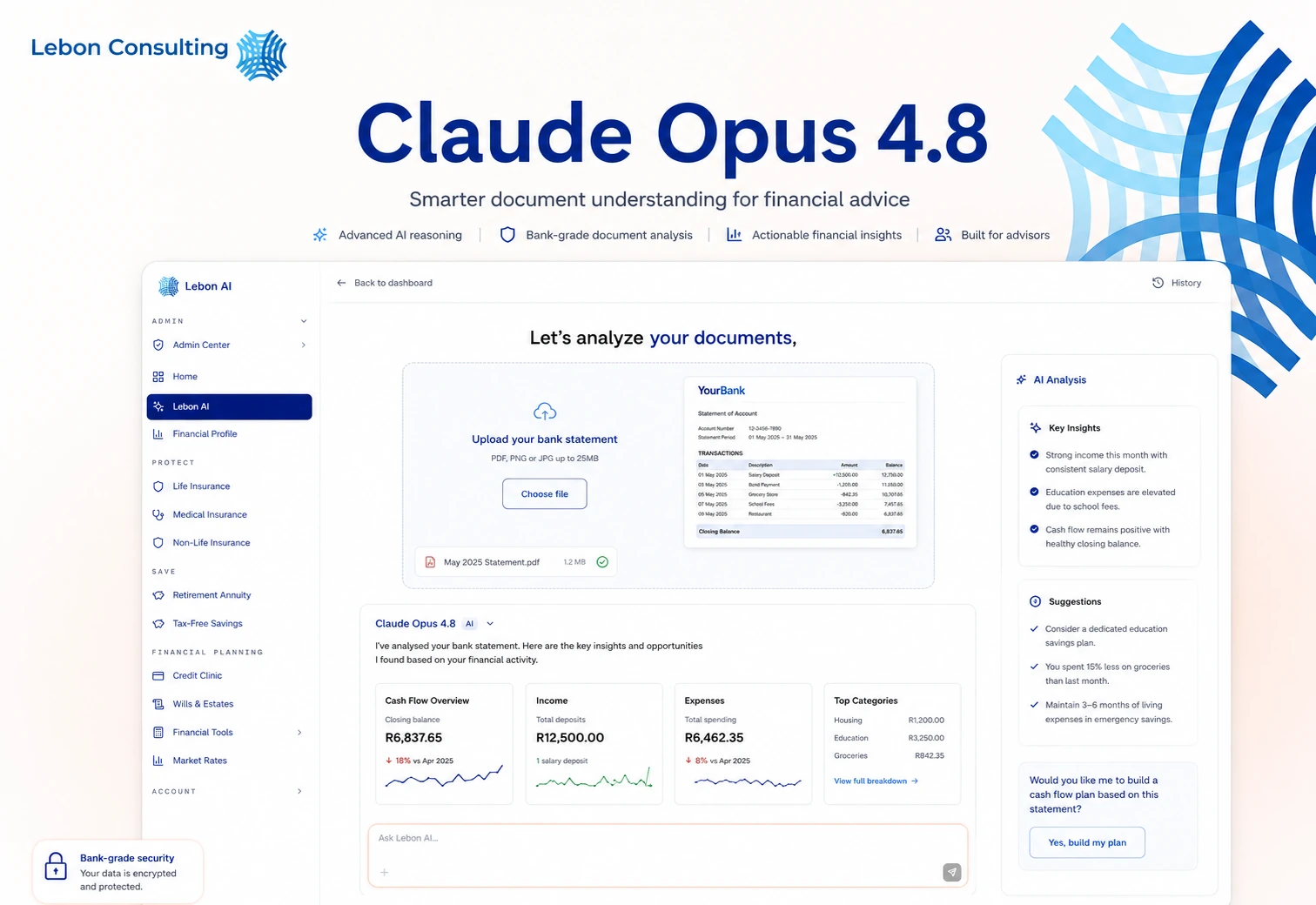
Anthropic releases Claude Opus 4.8: How to use it to analyse your finances with Lebon Consulting
Lebon Consulting is bringing Anthropic's Claude Opus 4.8 into Lebon AI for bank statement analysis, credit reviews, and insurance gap checks under adviser oversight.
Read article
King Price Insurance: Decreasing Car Insurance Premiums Explained for South Africans
How King Price Insurance's decreasing comprehensive car insurance premiums work, what is covered, and how to compare it against other South African insurers.
Read articleCompare the panel before you commit to a single insurer.
Request a personalised comparison through the client portal, or speak with an authorised adviser on WhatsApp. We compare across the full Lebon panel — including Discovery, Sanlam, Old Mutual and Momentum.
Next steps
- 01EstimateUse the life cover calculator to frame the need.
- 02CompareReview panel options across premium, benefits and exclusions.
- 03ApplyProceed through the Lebon Consulting client portal when the advice record is clear.
Sources referenced
- https://www.sars.gov.za/types-of-tax/personal-income-tax/filing-season/how-does-auto-assessment-work/
- https://www.sars.gov.za/types-of-tax/personal-income-tax/filing-season/
- https://www.sars.gov.za/media-release/sars-rolls-out-phased-filing-season-urges-taxpayers-to-wait-their-turn/
- https://www.sars.gov.za/latest-news/check-your-auto-assessment-status-and-wait-for-the-notice-2/
- https://www.sars.gov.za/faq/how-do-i-declare-additional-medical-expenses-on-my-return/