
Tax Calculator 2026 (South Africa): SARS 2026/27 Rates & the Four Levers That Move Your Answer
Calculate your 2026 South African income tax and take-home pay, then watch four legal levers — retirement, donations, a TFSA and your medical credit — redraw where your salary actually goes.

What this article gets at
Know the starting number
Tax on R600,000 for 2026/27 is R132,907 if you claim nothing — an effective 22.15% in the 36% bracket.
Four legal levers
Retirement (S11F) and donations (S18A) cut taxable income; the medical credit (S6A) cuts the bill; a TFSA shelters growth.
Lowest tax ≠ most wealth
Donations cut tax but give cash away. The right mix depends on liquidity, your goals and cash flow — not just the tax line.
Educational content only. This is not personal tax, financial or legal advice. Figures are estimates based on the published SARS tables and ITR12 rules; confirm your position with a registered tax practitioner.
On this page
Income tax & take-home calculator
Where your salary goes
Estimate only, for a tax resident. Uses the published SARS tables and the standard S11F / S18A / S6A rules; it ignores travel allowances, lump sums, capital gains and the two-pot component. Confirm your position with a registered tax practitioner.
This piece grew out of a real planning question: what is the tax on R600,000 for someone aged 36, and how low can it legally go? The calculator above answers the first half — for a 36-year-old earning R600,000 in 2026/27, the answer is R132,907 a year, an effective rate of 22.15% in the 36% marginal bracket. The rest of this article answers the second half: how far that number can legally fall, and what it costs you to get there. Along the way it clears up a naming trap that trips up almost everyone searching for a "tax calculator 2026".
Which year is the "2026 tax year"?
SARS names a tax year by the calendar year in which it ends. So the 2026 year of assessment runs from 1 March 2025 to 28 February 2026 — that is the return most people file from mid-2026. The year you are living and earning in right now is the 2026/27 year (1 March 2026 to 28 February 2027), which closes in the 2027 year of assessment.
This matters because planning only helps for a year that is still open. The brackets in the calculator default to 2026/27 — the year you can still influence — but the toggle lets you check the 2026 figures for the return that is due now. The 2026 Budget, tabled on 25 February 2026, shifted the brackets up 3.4% for inflation, the first such relief since 2023/24.
It is worth being precise about how the R132,907 is built, because the same arithmetic underpins every scenario below. On a R600,000 taxable income the tax before rebates is R150,727; subtract the R17,820 primary rebate and you are left with R132,907 payable, which is R11,075.58 a month off your payslip as PAYE. Nothing about that number is a choice — it is what you pay if you claim nothing. Everything interesting happens once you start using the deductions and credits the ITR12 was built to capture.
What the ITR12 actually lets you claim
The annual return — the ITR12 — separates two very different mechanisms. Deductions reduce the income that gets taxed; their value depends on your marginal rate, so a deduction is worth more the higher your bracket. Credits reduce the tax bill itself, rand for rand, regardless of bracket. Optimising your tax affairs is mostly a matter of knowing which boxes on the ITR12 turn which lever, and having the paperwork to support each one.
Deductions that reduce your taxable income
Retirement fund contributions — Section 11F. The most powerful lever for a salaried earner. You may deduct the lesser of 27.5% of the greater of your remuneration or taxable income, and R430,000 a year — a cap lifted from R350,000 on 1 March 2026, its first move since 2016. At R600,000 the 27.5% ceiling is R165,000, comfortably inside the cap. Crucially, anything you contribute over the limit is not lost: SARS programmatically carries the excess forward to the next tax year, where it counts toward that year's deduction.
Donations to Section 18A organisations. Donations to a SARS-approved public benefit organisation are deductible up to 10% of taxable income, with the excess again carried forward. You need a valid Section 18A tax certificate, and the PBO number must be entered on your ITR12, where SARS validates it automatically. The honest framing: this is not a way to keep more money — you are giving it away — but if you were going to give anyway, the deduction means SARS effectively co-funds the gift.
Home office expenses — Section 11(a), read with s23(b) and s23(m). As a salaried employee your ability to claim general expenses is heavily restricted, but a home office can qualify if you meet strict criteria: the space must be specifically equipped and used solely for your trade (a dedicated study, not the dining table), you must perform more than half of your duties from it, and you need a letter from your employer confirming you are permitted to work from home. Most salaried earners will not clear all three bars, which is why this lever rarely features in the headline scenarios below — but for genuine remote workers it is real.
Travel expenses. If your package includes a taxable travel allowance (IRP5 code 3701), you can deduct business travel — but only against a meticulous logbook of daily business kilometres. No logbook, no deduction. It is the most commonly forfeited claim on the return, purely for want of record-keeping.
Credits that reduce your tax bill directly
Medical scheme fees credit — Section 6A. A flat monthly credit that comes straight off your tax, regardless of your bracket: R376 each for the main member and first dependant, and R254 for every dependant after that (the 2025/26 figures were R364 and R246). Because it is fixed, it does not change which planning route is best — it simply lowers every scenario by the same amount.
Additional medical expenses credit — Section 6B. For high out-of-pocket costs. Under 65 and without a disability, the credit is 33.3% of the amount by which your qualifying out-of-pocket expenses plus "excess" scheme contributions (those above three times your Section 6A credit) exceed 7.5% of taxable income. It is a high threshold, so it tends to matter only in years with a major medical event.
One credit people still ask about no longer applies: the residential solar tax credit (25% up to R15,000) existed only for the 2024 year of assessment. It is not available for 2026/27, so leave it out of your planning.
R600,000, the default versus full optimisation
To see what these levers are worth, start with the two extremes. Scenario A claims nothing. Scenario B is fully optimised: the maximum R165,000 into a retirement annuity, the maximum R43,500 donation (10% of the post-RA R435,000), and a single-member medical credit.
| Metric | A · No interventions | B · Fully optimised |
|---|---|---|
| Gross salary | R600 000 | R600 000 |
| Less: RA deduction (S11F) | R0 | (R165 000) |
| Less: S18A donation | R0 | (R43 500) |
| Final taxable income | R600 000 | R391 500 |
| Marginal bracket | 36% | 31% |
| Net tax payable (2026/27) | R132 907 | R57 296 |
| Effective tax rate | 22.15% | 9.55% |
Two deductions move R600,000 out of the 36% bracket into the 31% one; the medical credit trims the bill again. Toggle Monthly to see the same figures per month. Rates and percentages do not change between views.
Two deductions move you out of the 36% bracket and into the 31% one, and the medical credit shaves the bill again. Net tax falls from R132,907 to about R57,296 — roughly R75,611 saved for the year, with the effective rate more than halving. On the 2025/26 rates the same exercise lands at R135,632 versus R62,269, a R73,363 saving; the shape is identical, the inflation-adjusted brackets just nudge the figures.
> The retirement contribution alone carries most of the benefit — and it does double duty: the R165,000 saves you tax today and compounds tax-free inside the fund for retirement.
What "take-home" really means
Here is where the comparison gets honest. "Lowest tax" and "most money in your pocket" are not the same thing, because two of these levers spend cash to save tax.
In Scenario A you pay R132,907 in tax and keep R467,093 as liquid cash — about R38,924 a month — with nothing saved. In Scenario B your tax drops to R57,296, but you also spent R165,000 on the RA and R43,500 on the donation, so liquid take-home cash falls to about R334,204 (~R27,850 a month). Your monthly spendable cash drops by roughly R11,074 — yet your total retained wealth (cash plus the RA asset) rises to about R499,204, because SARS subsidised R75,611 of those contributions. You feel poorer month to month and are wealthier overall.
That tension is why a third route matters. Scenario C — the "smart saver" — maxes the R165,000 RA and claims the medical credit but makes no donation. Tax lands around R72,500, liquid cash is about R362,500 (~R30,208 a month), and because nothing is given away, total retained wealth is the highest of the lot at about R527,500. You have simply redirected money that would have gone to SARS straight into your own retirement.
Scenario D: adding a tax-free savings account
A TFSA behaves unlike the deductions. Contributions are not tax-deductible — you fund it with after-tax money, so it does not lower this year's taxable income. Its power is on the other side: all interest, dividends and growth inside it are exempt forever, withdrawals are tax-free, and the 2026/27 annual limit is R46,000 (up from R36,000), with a R500,000 lifetime cap. Over-contribute and SARS levies a 40% penalty on the excess, so the limit applies across all your TFSAs combined.
Scenario D keeps the R165,000 RA and splits the R43,500 that was a pure donation in B between giving and a TFSA. Split 1 sends 60% to the TFSA (R26,100) and 40% to a donation (R17,400); Split 2 reverses it. Both TFSA amounts sit safely under the annual limit.
| Metric | A · Default | B · Optimised | C · Smart saver | D1 · 60% TFSA | D2 · 40% TFSA |
|---|---|---|---|---|---|
| Taxable income | R600 000 | R391 500 | R435 000 | R417 600 | R408 900 |
| Estimated tax | R132,907 | R57,296 | ~R72,500 | ~R67,100 | ~R64,400 |
| RA savings | R0 | R165 000 | R165 000 | R165 000 | R165 000 |
| TFSA savings | R0 | R0 | R0 | R26 100 | R17 400 |
| Donation outflow | R0 | R43 500 | R0 | R17 400 | R26 100 |
| Monthly spendable cash | R38,924 | R27,850 | R30,208 | R27,033 | R27,258 |
| Total retained wealth | R467 093 | R499 204 | R527 500 | R515 500 | R509 500 |
Annual figures by default; toggle Monthly to divide rand amounts by 12. The 'Monthly spendable cash' row is already monthly and is unaffected by the toggle. Tildes mark rounded estimates.
The verdict on Scenario D is that it buys you a balanced middle ground. By redirecting R26,100 out of a permanent donation and into your own TFSA, Split 1 lifts total retained wealth to about R515,500 — roughly R16,000 more in your corner than the all-donation Scenario B — while you still give R17,400 to a cause and claim the matching deduction. And the money in the TFSA now compounds in a completely tax-free environment alongside the RA, which is about as efficient as long-term wealth building gets in South Africa.
The caveat the comparison hides
A rand in a retirement annuity is not the same as a rand in cash or a TFSA. RA money is locked until age 55, and when you eventually draw it, the income portion is taxed at your marginal rate then — so part of today's deduction is really tax deferred, not tax avoided. A TFSA, by contrast, is fully liquid and never taxed again, and cash is already yours.
That is why the "retained wealth" column slightly flatters the RA-heavy routes, and why the "best" scenario is genuinely personal. Scenario C wins on raw retained wealth, but only if you are comfortable locking the most away and giving nothing. Scenario D keeps more liquid and more flexible. Scenario B does the most social good. The right balance depends on when you will need the money, what your tax rate is likely to be in retirement, and what you want your money to do — which is exactly the judgement a licensed adviser is for, not a calculator. You can frame the retirement side of that picture with our smart money tools, then bring the numbers to a review.
This article and the calculator are general information, not financial, tax or legal advice, and do not consider your personal circumstances. Figures are estimates based on the SARS tax tables published after the 2026 Budget (25 February 2026) and the published ITR12 rules; some optimised scenarios are rounded. Tax law changes — before acting, speak to a registered tax practitioner or a licensed financial adviser, and always confirm current rates against sars.gov.za. Lebon Consulting is an authorised Financial Services Provider, FSP No. 52013.
Lebon Consulting
Reviewed by Isaiah Mphaloane, Lead Advisor and Key Individual (FSCA Fit and Proper). Authorised Financial Services Provider, FSP 52013. Articles are reviewed for compliance before publication and reflect the perspective of a licensed adviser, not the product provider.
Frequently asked questions
Is the 2026 tax year the same as 2026/27?
No. The 2026 tax year runs 1 March 2025 to 28 February 2026. The 2026/27 year runs 1 March 2026 to 28 February 2027 and ends in the 2027 year of assessment. The calculator covers both — use 2026/27 for planning the year you are in, and "2026 yr" for the return you file from mid-2026.
What is the tax on R600,000 for 2026/27?
For an individual under 65 with no deductions, R132,907 after the primary rebate — an effective rate of 22.15%, sitting in the 36% marginal bracket. Fully optimised, the same salary can fall to roughly R57,296 (an effective 9.55%), as the tables show.
How much can I put into a retirement fund tax-free?
The lesser of 27.5% of the greater of your remuneration or taxable income, and R430,000 a year for 2026/27. On R600,000 that ceiling is R165,000. Contributions above the limit are carried forward by SARS to the next year.
Does a TFSA reduce my tax this year?
No — TFSA contributions are not deductible, so they do not lower your taxable income now. The benefit is that all growth and withdrawals are tax-free for life. The 2026/27 annual limit is R46,000, and over-contributing triggers a 40% penalty.
Which scenario leaves me with the most money?
On raw retained wealth, the "smart saver" route (RA only, no donation) wins at about R527,500, because nothing is given away. But it also locks the most money in a retirement fund until 55. A TFSA split keeps more of your wealth liquid; a full donation does the most good. There is no single best answer — it depends on your goals and cash flow.
Make Lebon Consulting a Preferred Source
Want South African financial guidance you can trust to show up in Google's AI answers? In Google Search, open Search personalisation → Preferred sources and add lebonconsulting.co.za. Preferred sources are highlighted in AI Overviews and AI Mode.
Recent articles for South African policyholders.
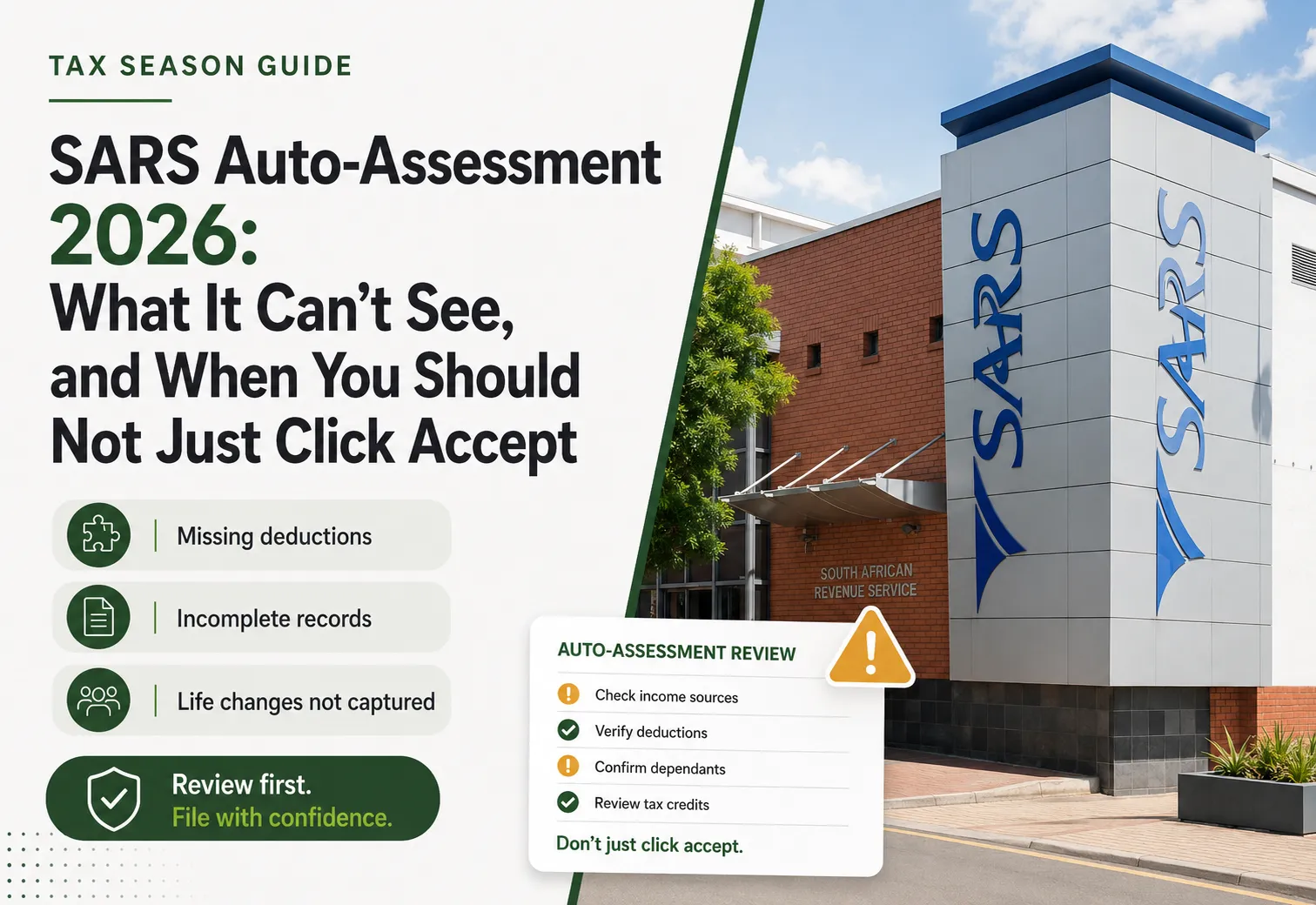
SARS Auto-Assessment 2026: What It Can't See, and When You Should Not Just Click Accept
SARS pre-fills millions of returns from third-party data — but it can't see out-of-pocket medical, donations, side income or RA top-ups. Here's the decision rule before you click accept.
Read article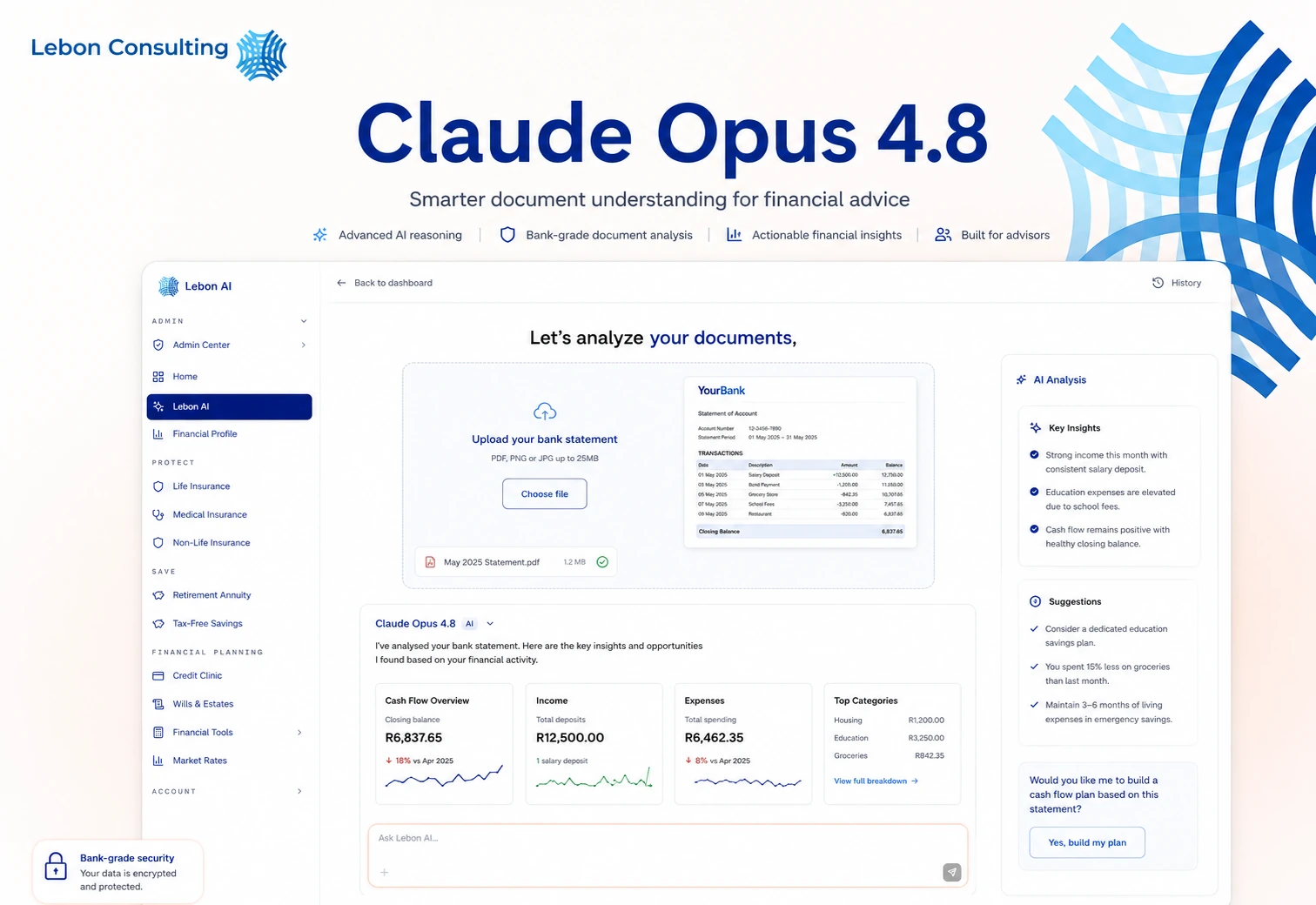
Anthropic releases Claude Opus 4.8: How to use it to analyse your finances with Lebon Consulting
Lebon Consulting is bringing Anthropic's Claude Opus 4.8 into Lebon AI for bank statement analysis, credit reviews, and insurance gap checks under adviser oversight.
Read article
King Price Insurance: Decreasing Car Insurance Premiums Explained for South Africans
How King Price Insurance's decreasing comprehensive car insurance premiums work, what is covered, and how to compare it against other South African insurers.
Read articleTurn the calculator into a tax and retirement plan.
The calculator frames the number; an adviser structures it. Speak to a Lebon adviser about retirement-fund contributions, Section 18A donations and tax-free savings — through the client portal or on WhatsApp.
Next steps
- 01EstimateUse the life cover calculator to frame the need.
- 02CompareReview panel options across premium, benefits and exclusions.
- 03ApplyProceed through the Lebon Consulting client portal when the advice record is clear.